|
NORTH AND WEST of the Alexander Archipelago and our other trips is Russell Fjord. One cannot speak of this area without using superlatives; North America's largest glaciers, the world's tallest coastal mountains, and the world's largest protected wilderness area are all here, yet the area is virtually unknown.
Here the towering St. Elias mountains soar from the Pacific Ocean to heights of 18,000 feet. Moist winds from the Gulf of Alaska rise, cool, and dump huge quantities of snow onto the flanks of the mountains. The snow never melts, instead compressing into ice, which flows like rivers back down to salt water. The largest of these "tide-water" glaciers reaches salt water in a 5-mile wide, 300-foot high wall of ice. This is the Hubbard, North America's largest tide-water glacier, and it nearly blocks the mouth of the fjord. Numerous other, smaller glaciers "hang" in valleys. |
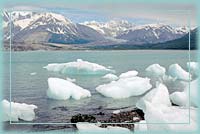 The work of the glaciers which carved this continent is still underway here. In 1986 the Hubbard Glacier made national news by "surging" forward and actually sealing off the entrance of Russell Fjord, causing it to become a lake, and the water level to rise. After four months, the ice dam broke, the lake became a fjord again, and the terminus of the glacier temporarily receded. Glaciologists predict, however, that the glacier will advance again soon, making Russell Fjord a lake once more.
This area, on no route to anywhere, is truly remote, difficult and expensive to reach. Part of the Tongass National Forest's Russell Fjord Wilderness Area, it is rarely visited. No cruise ships ply these waters, and it is very unusual to see or hear any signs at all of humans. It is the quintessential Alaskan wilderness, offering stunning views of the St. Elias Mountains as a backdrop to our paddling in the calm waters of the fjord, itself a beautiful steep-walled valley bejeweled with waterfalls and flooded by a long finger of the sea. |
|||
|
We start this
expedition in the town of Yakutat, located where the "panhandle" that is
the Southern part of the state constricts to meet the "pan." The short sea
plane flight from Yakutat is like a ride in a time machine.
From ancient spruce and hemlock forest on the coast we fly to a place where evidence of recent glaciations surrounds us. The first few pioneer plants - dryas, fireweed, and a few willows - grow in scattered pockets on a landscape of barren rock and gravel, much of it having been under ice just 50 years ago. Old growth rain forest is nearly a thousand years away.
|
On our last day, the sea plane returns and conveys us back to the twentieth century, but we've been permanently changed; it will be difficult to view the landscapes of this continents without imagining the time when they looked like Russell Fjord.
|
|||
| Trip Name:
Glacier Passage Expedition Trip Lengths: 5-10 days Distance Paddled: 25-50 miles Activities: Paddling, photography, glacier watching, hiking Highlights: Watching, photographing, and listening to tidewater glaciers, fantastic scenery, seals on icebergs, real wilderness solitude.
|
Pricing: Prices
are per person. Glacier Passage 5
day/ 4 night $2170.00 Electronic mail request: spiritwalker@glacierbaytravel.com A 50% deposit is due at the time of booking and the balance is due 30 days prior to the trip's departure. Included in the price: all charter transportation, 2 person kayaks with accessories; emergency communication, signaling and first aid equipment; all cooking gear, utensils and superb meals; water bottles; 2 person tents; sleeping bags and pads; rain gear, rubber boots and dry bags. Not included in the price: personal clothing, getting to and from the departure town and activities before and after the trip. |
|||
|
Cancellation Fees If you cancel your reservation:
|
||||
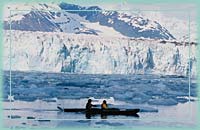
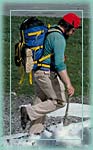 We
begin our trip in a side-arm of the fjord. We explore along the rocky
shore as we navigate bends in the inlet on the way to the (relatively)
small glacier at its head, where we are likely to see a colony of harbor
seals. Everywhere are classic signs of glaciations, and vegetation in
various stages of succession, from barren gravel to alder and cotton wood
forest.
We
begin our trip in a side-arm of the fjord. We explore along the rocky
shore as we navigate bends in the inlet on the way to the (relatively)
small glacier at its head, where we are likely to see a colony of harbor
seals. Everywhere are classic signs of glaciations, and vegetation in
various stages of succession, from barren gravel to alder and cotton wood
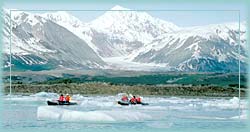
forest.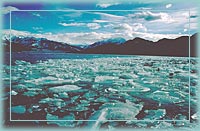 In
succeeding days we move to the mouth of the fjord and our encounter with
the Hubbard Glacier itself. As we slowly approach we see it gradually grow
in apparent size. When we are finally reach it, the mass of ice is
overwhelming. Sun glistens off deep blue patches where ice has recently
broken away. We are surrounded by ice bergs of all sizes. Porpoises and
seals appear and disappear. The sounds are amazing. Where we are used to
conversation and machinery, there there is a deep stillness only accented
by the perpetual bubbling of melting icebergs releasing ancient trapped
air pockets. Shrill cries of gulls accompany a multitude of groans,
clicks, cracks and pops coming from the ice itself as it slowly moves. And
periodically there is a grand CRASH! which drowns out everything else as
tons of ice break away from the terminus and fall into the water, renewing
the supply of bergs and throwing up a huge splash.
In
succeeding days we move to the mouth of the fjord and our encounter with
the Hubbard Glacier itself. As we slowly approach we see it gradually grow
in apparent size. When we are finally reach it, the mass of ice is
overwhelming. Sun glistens off deep blue patches where ice has recently
broken away. We are surrounded by ice bergs of all sizes. Porpoises and
seals appear and disappear. The sounds are amazing. Where we are used to
conversation and machinery, there there is a deep stillness only accented
by the perpetual bubbling of melting icebergs releasing ancient trapped
air pockets. Shrill cries of gulls accompany a multitude of groans,
clicks, cracks and pops coming from the ice itself as it slowly moves. And
periodically there is a grand CRASH! which drowns out everything else as
tons of ice break away from the terminus and fall into the water, renewing
the supply of bergs and throwing up a huge splash.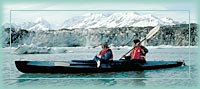 The
barren landscape, makes for interesting hiking. We walk along milky
glacial outwash streams and up beside a glacier for a view of the area. If
we are lucky, we will see some of the wolves, moose, mountain goats or
brown bears that live here.
The
barren landscape, makes for interesting hiking. We walk along milky
glacial outwash streams and up beside a glacier for a view of the area. If
we are lucky, we will see some of the wolves, moose, mountain goats or
brown bears that live here.